Press Release for SEO: What the Links Are Worth and What PR Link Building Does Instead
By Michael Carter
Filed under: Press Release Strategy
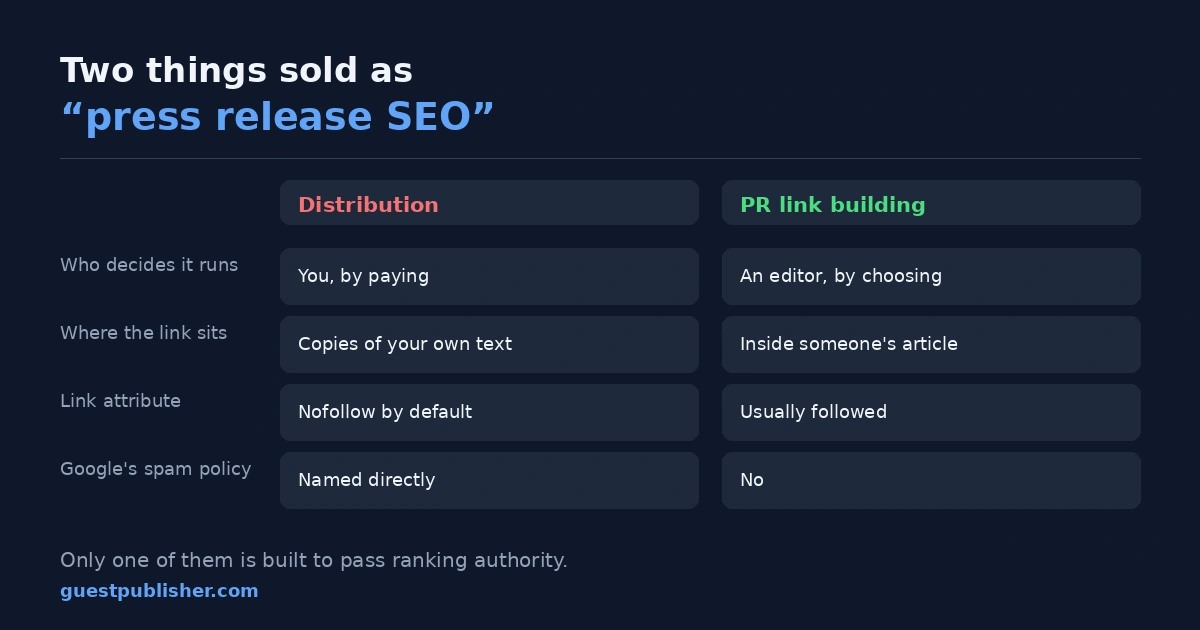
Two different things get sold under the same name, and the difference decides whether you get anything at all.
The first is sending a release over a newswire so it appears on two hundred sites with your link in it. The second is getting a journalist to write about you and link because the story was worth covering. Both get sold as press release for SEO. Only one of them moves rankings.
This article separates them properly, quotes what Google actually says rather than what people say Google says, and is specific about when a release is worth sending anyway.
Do press releases help SEO?
For rankings, through the links: no. That is the honest answer to the press release for SEO question, and the rest of this explains why.
For visibility, brand searches and occasionally a real editorial link as a second-order effect: yes, sometimes, and that is a different claim from the one being sold to you.
The reason people keep asking about press release for SEO is that the answer depends entirely on who they ask. A newswire will tell you its distribution builds authority. An SEO who tried it will tell you nothing happened. Both are describing the same outcome from different ends.
What Google actually says
This is where most articles on press release for SEO stop short. They quote an offhand remark from a Google employee in 2018 and leave it there. The documentation is more specific and easier to check.
Google's spam policies list, as an example of link spam, "links with optimized anchor text in articles, guest posts, or press releases distributed on other sites."
Press releases are named in the policy. Not implied, not inferred from a conference answer — written into the list.
The same documentation sets out what to do with promotional links: paid links for advertising or sponsorship are fine "as long as they are qualified with a rel="nofollow" or rel="sponsored" attribute value to the <a> tag."
Put those two together and the position is unambiguous. A link you placed yourself, in content you paid to distribute, with anchor text you chose, is expected to be marked so it does not pass ranking authority. That is why newswires apply nofollow by default, and it is why press release backlinks behave the way they do.
If the dofollow and nofollow distinction is not second nature yet, our explainer on incoming links and backlinks sorts out the vocabulary before you read the rest of this.
What the "200+ sites" actually are
Every distribution package advertises a syndication number. It is real, and it is also the most misunderstood figure in this market.
When a release is picked up by two hundred sites, those sites are mostly automated feeds. The release appears on a URL, usually under a generic news subdomain, often without the page ever being indexed. The copy is identical across all of them, because syndication is a copy.
So the two hundred press links you were sold are two hundred copies of one piece of content, nearly all nofollow, many never crawled. Counting them as two hundred backlinks is counting the same thing two hundred times, and it is the reason a press release backlinks report can look impressive beside no change in anything.
That is not fraud on the newswire's part. Syndication is what they sold you. The mistake is treating syndication as link building.
PR link building is a different thing entirely
Here is the part that gets left out, and it is the one with the actual value.
PR link building means pitching a story to journalists and editors so that they write about it and link to you inside their own article. Nobody distributed anything. A person decided your story was worth covering.
That link is editorial. It sits in a piece a human wrote, on a site with readers, in a context that makes sense. It is the kind of link every other tactic is trying to imitate.
The difference between the two approaches is not a matter of degree:
| Press release distribution | PR link building | |
|---|---|---|
| Who decides it runs | You, by paying | An editor, by choosing |
| Where the link sits | Syndicated copies of your own text | Inside someone's own article |
| Link attribute | Nofollow by default | Usually followed |
| Duplication | Same text on many domains | One original piece |
| What it costs | A distribution fee | Time, and a story worth telling |
| Named in Google's spam policy | Yes | No |
This is why link building PR and SEO teams increasingly do the same job in the same room. Where link building PR is done well, the brief is a story, not a target anchor text. The work that earns links is the work that earns coverage.
What PR link building actually involves
It is less glamorous than it sounds and more repeatable than most people expect.
You need something that is news. A product update is not news. Original data is. A survey of your own customers, a figure nobody has published before, a response to something happening in your industry this week — these give a journalist a reason to write.
You pitch individuals, not lists. A relevant reporter who covers your sector, by name, with the story in the first two lines. Blasting a release to a media database is distribution again under another name.
Most pitches fail. That is normal and it is priced into the tactic. The hit rate is low and the value per hit is high, which is the opposite shape to submission tactics where the hit rate is high and the value is near zero.
The link is a by-product. You are buying coverage. If the coverage happens, the link usually comes with it; if you optimise the pitch for the link, you lose the coverage.
The mechanics overlap heavily with guest post pitching, and if you have not done either, our guide to guest posting outreach covers the pitching process end to end — the same discipline applies to journalists, with a shorter attention span at the other end.
So is press release link building ever worth it?
Press release link building, in the sense of sending releases to accumulate links, is not a strategy I would fund, and press release for SEO framed that way is money spent on the wrong thing. The links do not count, the content is duplicated, and the tactic is named in the policy.
But a press release has uses that have nothing to do with links, and they are real:
It puts your version on the record. When something happens — a funding round, a leadership change, a problem you need to get ahead of — a dated, public statement you control is worth having.
It surfaces on brand searches. Someone searching your company name finds the announcement. That is reputation management, and it works.
It occasionally starts something. A journalist monitoring the wire sees the story and writes their own piece. That piece carries a real link. The release did not build the link; it put the story where someone could find it.
It is the format editors expect. If you are approaching news outlets, sending something in proper release format removes a reason to ignore you. This is the one press release for SEO argument that holds up, and it has nothing to do with links.
That last one is where most releases fail before anyone reads them. Our free press release checker marks what is missing — length, a real quote from a named person, a media contact, third-person tone — before you send it anywhere.
Which press links are worth having
Not all press coverage is equal, and the filter is the same one that applies to any link.
Does the outlet have readers?
A trade publication with ten thousand engaged subscribers is worth more than a syndicated feed with a high authority score and no audience.
Is it relevant to what you sell?
A link from a publication your buyers read does something a general news site does not.
Is the link editorial?
Inside the article, in a sentence that made sense to write — not in a boilerplate block at the bottom under "About the company".
Is it one of one?
A piece written about you is worth more than the same text on fifty domains, however many of those domains have a logo you recognise. Syndicated campaigns fail this test by design, because syndication is duplication.
Press links that pass all four are among the best links available. They are also the hardest to get, which is the honest trade.
How to tell whether a release did anything
This is the part nobody measures, which is why the tactic survives on belief.
After a release goes out, three things are worth checking, and all three take minutes.
Search a distinctive sentence from the release in quotes. You will see how many of the syndicated copies are actually indexed. On most campaigns the answer is a small fraction of the number you were sold. Anything not indexed is not a link in any sense that matters.
Check whether any coverage was written rather than copied. Search your company name with a date filter. A piece someone wrote in their own words is the only outcome in a press release for SEO campaign that carries an editorial link.
Look at your brand search volume, not your rankings. If a release does anything measurable, it usually shows up as people searching your name — not as movement on a commercial keyword. Judging press release for SEO by ranking changes on money terms is measuring the wrong thing and will tell you it failed even in the cases where it worked.
Run those three checks after one campaign and you will know whether to fund a second. Most people never run them, which is how a press release backlinks report full of syndicated duplicates keeps getting signed off.
If you want links, start somewhere else
PR link building works, and it is slow, uncertain, and dependent on having something genuinely newsworthy. For most businesses it is a channel to build alongside something more predictable, not instead of it.
If you need placements on a schedule, buying them on real publications is the direct route — every listing on our guest post marketplace shows Domain Authority, Domain Rating, monthly organic traffic, traffic country, link type and price before you order, so you can check an outlet has readers rather than assume it. Before you pay for any placement, how to vet a guest post site covers the checks that catch the sites not worth buying from.
And if the plan was free submission links, blog submission sites and the rest of them goes through what each type is actually worth, which is less than the lists suggest.
The short version
Do press releases help SEO? Not through their links. Press release backlinks are nofollow by default, syndicated copies rather than distinct links, and press releases are named directly in Google's link spam policy alongside guest posts with optimised anchor text.
Press release for SEO, as a link tactic, is the wrong frame. PR link building — earning coverage that carries an editorial link — is the right one, and it is a different job requiring a different input: a story worth writing about rather than a distribution budget.
Send releases for the reasons releases are good: the record, the brand search, the chance a reporter picks it up. Treat press release for SEO as a side effect rather than the plan. Count the links as a bonus you did not pay for, because that is what they are.