Blog Submission Sites, Directories and Forums: What Free Link Lists Are Actually Worth
By Michael Carter
Filed under: SEO & Link Building
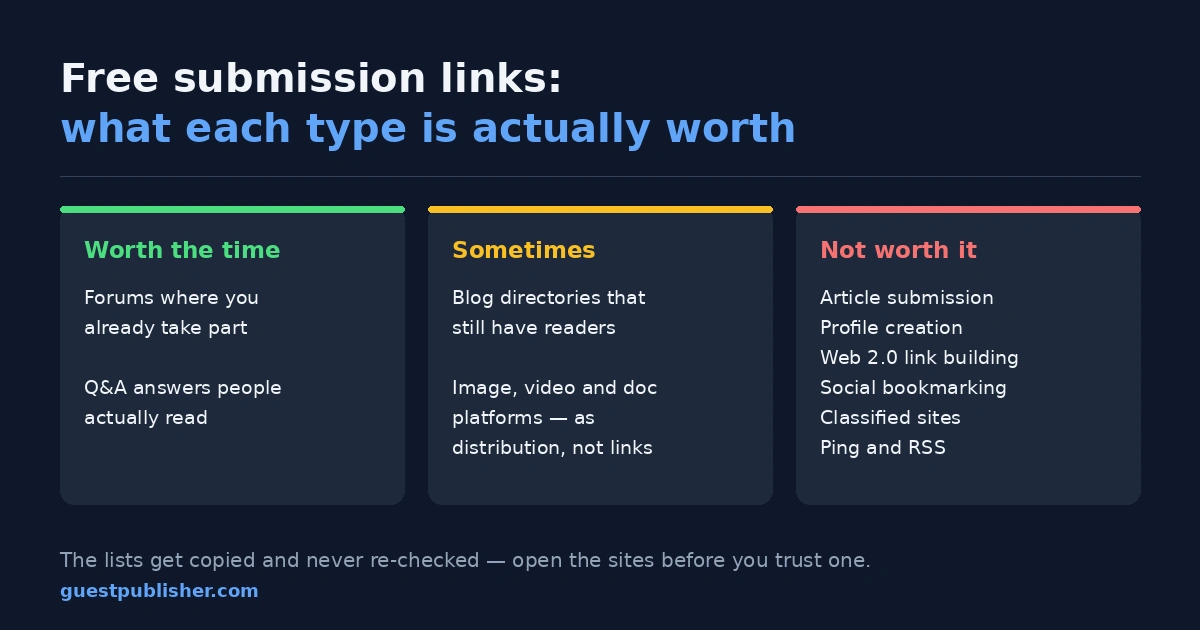
Search for blog submission sites and you will find the same article forty times: a table of thirty URLs, a Domain Authority number beside each one, and a download button.
Open the comments on any blog submission sites post. Someone will be reporting that half the links are dead, and the author will have replied "I'll look into it" two years ago.
That is the real state of blog submission sites, and it is the thing none of those lists tell you. This article does the opposite of a list. It goes through each type of free submission site, says what the link is actually worth in 2026, and tells you which ones are not worth the hour it takes to fill in the form.
What these sites are, and why the lists exist
A submission site is any site where you can add a URL yourself — no editor, no pitch, no permission. You fill in a form, your link appears.
That is the entire appeal, and it is also the entire problem. A link anyone can place is a link that costs nothing to place, and search engines worked that out a long time ago.
Blog submission sites lists exist because they are easy to write and they rank. Nobody maintains them, because maintaining them would mean opening three hundred sites every few months and checking which ones still have a working form. I have not done that either, which is exactly why there is no list in this article.
Blog submission sites and directories
Blog submission sites are blog directories: you submit your feed or your homepage, and the site adds you to a category page.
Most of these were built between 2006 and 2012, when blog directories sent real traffic. The ones still online are mostly abandoned category pages with hundreds of outbound links on them. A link on a page like that passes close to nothing, and the page itself usually has no readers.
A small number are still genuinely active and get visitors. Those are worth submitting to, and you will find them by looking rather than by downloading a list of blog submission websites that was copied from another list. The same goes for any blog submitter tool that promises to post you to three hundred of them at once: it will succeed, and nothing will happen.
You will also see these lists sold as blogs with dofollow links, or as a free dofollow blog sites list, or bundled into a high pr backlinks list. If the dofollow and nofollow wording is not second nature yet, our explainer on incoming links and backlinks sorts the vocabulary out. The dofollow part here is true and beside the point. A followed link from a page with no readers and four hundred outbound links is still a followed link from a page that does not matter.
Directory submission sites are the same tactic with a different name. Any directory submission sites list you open will be optimised for free directory submission sites and high DA directory submission sites, and the sites behind those phrases are almost all the generic web directories that replaced each other through the 2000s. Directory submission in SEO was a real tactic once. It stopped being one when Google got good at recognising a directory.
One thing to watch in the directories that are still running: a lot of them will only list you if you link back to them. That is a reciprocal link, and what a reciprocal link is worth is worth reading before you agree to one.
The honest version: treat blog submission sites the way you would an industry association listing. Submit to the one or two that matter, not the thirty that do not.
Article submission sites
Article submission sites take a whole article and republish it on their domain with your link in it.
This is the one I would skip entirely. Free article submission sites were the engine of the article-marketing era, and Google spent a lot of effort specifically devaluing them. Publishing your article on a site that publishes everybody's article puts your content next to content you would not want to be associated with, and the link sits in an environment that was built for links.
There is a second cost people forget. If you publish the article there and then want it on your own site, you now have the same piece in two places and the submission site usually ranks above you.
Every article submission sites list leads with high DA article submission sites, because the DA is the only thing these platforms can advertise. That tells you what the traffic looks like. Article submission in SEO is now mostly a phrase that survives in listicles rather than a tactic anyone serious runs.
Social bookmarking and web 2.0 sites
Social bookmarking sites list posts promise sites where you save a link publicly. The few social bookmarking sites that still have real users are worth using as what they are — places to share something — and worthless as places to plant links, because the links are nofollow and the pages get deindexed.
Social bookmarking in SEO is sold on volume: free social bookmarking sites and high DA social bookmarking sites, fifty of each. Volume is the problem. Fifty accounts created in an afternoon to save the same URL is a pattern, and it is not a subtle one.
Web 2.0 sites are a different thing: free blog platforms where you create a sub-site and write posts that link back to you. A web 2.0 sites list is really a list of free hosting, and web 2.0 submission sites is the same list again under another heading.
So what is web 2.0 backlinks, in plain terms? Links from pages you built yourself on somebody else's domain. Once you put it that way, the answer to whether they work mostly answers itself.
This one deserves a clear answer, because it is sold hard. Building ten blogs on free platforms and linking them all to yourself is a private blog network with extra steps. It is detectable because it looks exactly like what it is: new sub-domains with no audience, all pointing one direction.
If you genuinely publish on Medium or a similar platform because people read you there, that is publishing. Creating accounts on free web 2.0 sites to hold links is not, and web 2.0 backlinks built that way are the easiest kind to spot.
Profile creation sites
Profile creation sites are forums, directories and communities where your user profile has a website field.
Filling in that field is not link building. It is filling in a field. Nearly every one of these profile backlinks is nofollow, most profile pages are not indexed, and the ones that are indexed carry a page with your username and nothing else.
Any profile creation sites list you download will be sorted by score, and high DA profile creation sites is the phrase doing the selling. Profile backlinks SEO advice always skips this part: they are worth roughly what they cost to make, which is nothing.
The one case where it matters: profiles on platforms your customers actually use, filled in properly, because they get seen by people. That is brand work, and it is worth doing. Just do not count it as links.
Forum submission sites
Forum submission sites is the list-building name for "forums where you can post a link", and forum posting sites is the same idea worded differently. The honest version of this is much narrower and much better.
Being a real participant in a forum your buyers read is one of the most underrated things in this whole category. People find you, remember you, and sometimes link to you from their own sites. That is a genuine channel.
Dropping a link into a thread you have no other presence in is spam, gets removed, and in an active forum gets you banned before it is indexed. The difference is not the forum — it is whether you were there already.
Blog commenting
Blog commenting belongs in the same family and has its own answer, which is long enough that we wrote it separately: what a comment link is actually worth. The short version is that comment links carry rel="ugc" and are generally not followed, so they will not move rankings — but commenting where you are known can still earn you readers, which is the same pattern as forums and Q&A.
Question and answer sites
A question answer sites list is usually Quora plus a dozen clones, and Q&A sites for SEO is the category name.
The links are nofollow. Quora backlinks and Reddit backlinks pass no ranking authority at all, and anyone telling you otherwise is selling something. The value, where there is any, is that people read the answer. A good answer on a question with ongoing search traffic can send you visitors for years. A link dropped under a one-line answer does nothing and usually gets collapsed.
So how to get backlinks from Quora is the wrong question. How to get read on Quora is the right one, and the link follows from it.
Treat Q&A as a place to be useful in public. The link is a side effect.
Classified, PDF, image, video and ping sites
These five get grouped because the answer is the same for all of them.
Classified submission sites list posts point at free ad sites. Free classified submission sites and high DA classified sites are the phrases; the reality is listings that expire, pages that are not indexed, and in many cases a nofollow link anyway. Classified sites for SEO is a tactic that stopped working before most people reading this started doing SEO.
Image submission sites list and free infographic submission sites point at image-sharing galleries. If you have made a genuinely good infographic, putting it where designers look can earn a real link from someone who writes about it. The gallery link itself is worth nothing. Image sharing sites for SEO is the wrong framing — image sharing sites for distribution is the right one.
PDF submission sites list and PPT submission sites are document-sharing platforms, and free PDF submission sites is how they are advertised. Document sharing sites for SEO has the same answer as the image one: the platform link is nothing, the distribution can occasionally be something.
Video submission sites list posts name video platforms. Video sharing sites for SEO is worth doing if you are making video, and pointless if you are uploading a slideshow to get a link. Free video submission sites will not change that.
Ping submission sites list is the one that is simply obsolete. Ping sites for SEO existed to tell search engines a page had updated, and RSS submission sites did the same job for feeds. Search engines stopped needing to be told years ago. There is no link and no benefit, and a ping submission sites list in 2026 is a historical document.
Why the DA number on these lists misleads you
Every list leads with Domain Authority, and it is the weakest possible thing to lead with.
Domain Authority is Moz's estimate of how strong a backlink profile looks. It is not a Google metric, it does not appear in any Google ranking system, and a site can have a high score while having no readers at all. One of the most-shared lists in this niche tells readers that a high DA means a site is trustworthy in Google's eyes. That is not what DA measures.
Check organic traffic instead. A submission site with DA 70 and no organic visitors is a page nobody reads, and a link on a page nobody reads behaves accordingly.
Why every list you find is out of date
This is the practical problem, separate from whether the tactic works.
Blog submission sites lists get copied. One person compiles thirty sites, forty others republish the same thirty, and nobody re-checks them. The same is true of every other list in this article. Sites close, forms break, domains get sold and redirected, and the list carries on being republished.
If you are going to work through a list of dofollow blog posting sites or any other, assume a third of the entries are dead before you start, and check the live page rather than the list entry. Open the site, find the form, and look at whether anything has been submitted recently. Dofollow blogs that were worth something in 2015 are mostly not worth something now, and "dofollow blog" lists are the ones copied most often of all.
What to do with the hour instead
If you have an hour and you want a link from it, here is the comparison that matters.
An hour on blog submission sites and the rest of them gets you perhaps six forms filled in, most nofollow, most on pages that are not indexed, with maybe one that survives.
An hour spent writing a genuinely useful answer where your buyers are, or pitching one real publication, gets you either nothing or something that actually counts. The distribution is worse and the expected value is higher.
If you want links that pass authority without the hunting, that is what paid placement on real publications is for — every listing on our guest post marketplace shows Domain Authority, Domain Rating, monthly organic traffic, traffic country, link type and price before you order, so you can see what you are getting rather than guessing from a list. If you would rather do it yourself, our guide to guest posting outreach covers finding and pitching sites, and how to vet a guest post site covers checking one before you pay.
The short version
Most free submission sites do nothing. Forums and Q&A sites can be genuinely valuable, but only where you are a real participant rather than a visitor with a link. Blog submission sites and directories are worth it for the handful that still have readers, and not worth it for the other three hundred on the list.
And whatever list of blog submission sites you end up using, open the sites before you trust it. The person who published it did not.