Forum Backlinks: What They Are Worth, What Google Says, and When They Are Worth Building
By Michael Carter
Filed under: SEO & Link Building
Forum backlinks are the oldest trick in link building, and the one with the widest gap between what people think they do and what they actually do.
The short version before the detail: almost every forum link you can place yourself carries rel="nofollow" or rel="ugc", which means it passes no ranking authority. And forum signature links are not merely ignored — they are listed by name in Google's own spam policy, with a worked example.
That is not the whole story, because forums still earn real traffic and real visibility for the people who use them properly. But it does mean that most of what is sold as forum link building is being sold on a benefit that does not exist. This covers what forum backlinks are, what Google's documentation says word for word, how to check a forum in thirty seconds, the one approach that still works, and what a forum link building service is actually delivering when you pay for one.
What forum backlinks are
A forum backlink is a link to your site from a discussion board — a phpBB or Discourse community, a subreddit, a Stack Exchange site, a niche industry forum, a Facebook group with a web-visible archive.
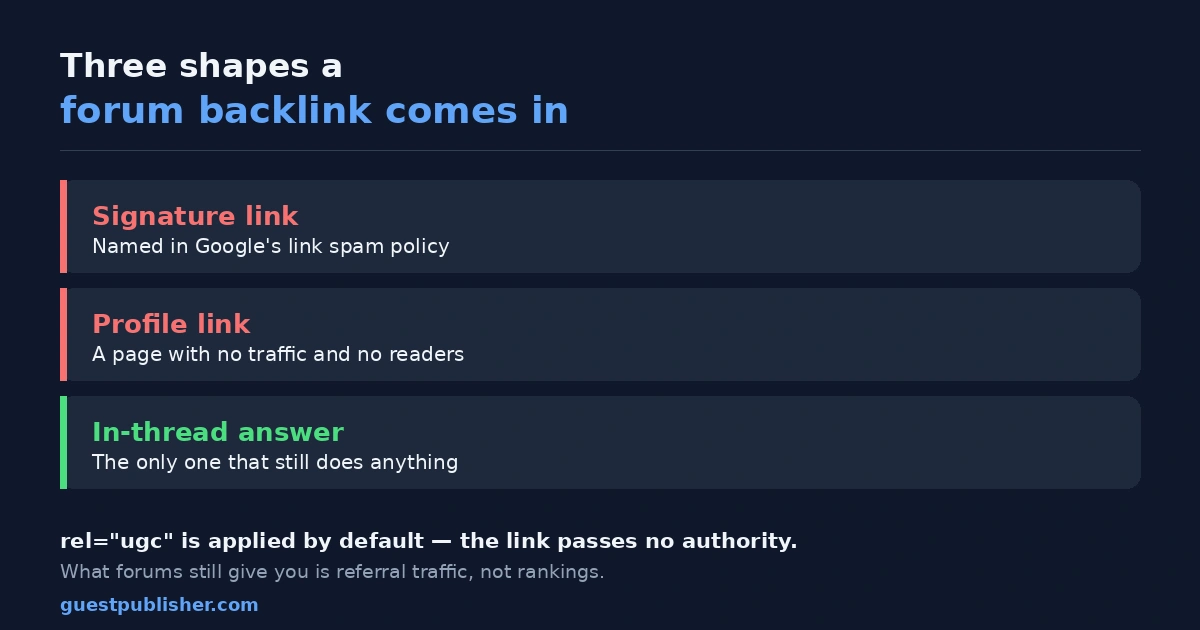
Forum backlinks come in three shapes, and the difference between them matters more than anything else in this article.
Signature links. Your profile holds a signature that appends to every post you make. Post two hundred times, get two hundred links. This is the shape that built the tactic's reputation in 2009 and the shape Google names in its policy.
Profile links. A website field on your member profile. One link per forum, usually on a page with no traffic and no inbound links of its own.
In-thread contextual links. You answer a question, and a link is part of the answer because the answer needs it. One link, inside a post a human will read, in a thread that may rank.
Everything that is still worth doing with forums lives in that third category. The first two are what people mean when they talk about getting backlinks from forums at volume, and they are the two that stopped working.
What Google actually says about forum links
This is the part most articles about forum backlinks in SEO skip, or paraphrase from memory. The documentation is public and specific, so here it is directly.
Google's spam policies for web search list examples of link spam. One of the bullets is:
Forum comments with optimized links in the post or signature
The documentation then gives an example of what it means, which is worth seeing because it is so close to what the tactic actually looks like in practice — a short agreeable reply, followed by a signature carrying three keyword-anchored links to a pizza business.
Read that bullet again, because the wording is precise. It is not "forum links are bad." It is forum comments with optimized links — links placed for the anchor text rather than for the reader. A link in a post you wrote to answer the question is not what the policy describes. A link dropped under "Thanks, great info!" is exactly what it describes.
The same documentation has a separate section on user-generated spam, which includes "Spammy posts on forum threads" among its examples. That one is aimed at the forum owner rather than the poster, and it explains why so many forums have quietly tightened up: a board that lets link-dropping run unchecked risks a manual action of its own.
So the honest position on backlinks in forum signatures is not that they are a grey area. They are an example in the policy. That is as clear as link building guidance gets.
Why almost every forum backlink is nofollow now
Even where no policy applied, the mechanics would still stop you.
Google asks site owners to mark links that visitors add — comments and forum posts — with rel="ugc". Its guidance on qualifying outbound links states that links carrying these attributes "will generally not be followed." Forum software ships with this applied by default, so the board does not have to decide anything for your link to be discounted.
There is one carve-out in the documentation, and it is the most interesting sentence in it: a site owner "might remove this attribute from links posted by members or users" who have consistently contributed high-quality content over time.
That is the entire legitimate route to a followed forum backlink, written by Google. Not volume, not software, not a service. Contribute to one community well enough, for long enough, that a moderator decides your links are worth following.
Nobody selling forum link building is doing that, because it cannot be done at scale and it cannot be done in a week.
Check it yourself in thirty seconds
Never take a vendor's or a list's word for whether a forum passes link equity. Attributes change, and most boards have tightened in the last few years without announcing it.
Open any recent thread on that forum that contains an external link. Right-click it, choose Inspect, and read the opening tag.
rel="nofollow"orrel="ugc"orrel="nofollow ugc"— the link passes no ranking authority- no
relattribute at all — it is a followed link, which on a public forum in 2026 is rare enough to be worth a note in your sheet
If the dofollow and nofollow vocabulary is not second nature yet, our explainer on incoming links and backlinks sorts out the attributes before you start checking.
So do backlinks from forums do anything at all?
Yes, three things — none of which is the thing they are sold for.
They send referral traffic, and it converts unusually well. This is the real value and it is routinely undersold. Someone reading a thread about the exact problem you solve, who clicks a link because it answers their question, arrives with more intent than almost any other visitor you can buy. A nofollow link that sends eleven people who needed what you sell beats a followed link from a site nobody reads.
They get pages discovered. Active forums are crawled constantly. A link in a busy thread is a reliable way for a new page to be found quickly, which is a small but genuine benefit on a site with weak internal linking.
They put you where answers get assembled. Forum threads are heavily represented in the sources that AI answer engines draw on, and a useful answer from you in a thread that ranks is visible to people long after it was posted. Nothing about this depends on the link attribute at all.
What they do not do is move a commercial keyword. If you build a thousand forum links this quarter and watch a money term, nothing will happen, and the reason is in the two sections above.
The one forum link building approach that still works
Forum link building for your site works when you invert the whole thing: stop treating the forum as a place to deposit links and treat it as a place where your buyers ask questions out loud.
Pick two communities, not fifty. Wide and shallow is the signature strategy under a different name. Two boards where your customers actually post, where you can read every new thread in fifteen minutes a day, will do more than a spreadsheet of forty.
Put the answer in the post. Write the reply so it is complete and useful with the link removed. If someone asks how to check whether a site sells links and you write three sentences on what to look for, the link to your longer guide is a source, not a pitch. If you write "Great question, I covered this here," you have written the spam example.
Link once, and only where it is the source. One link in a thorough answer reads as citation. Two links reads as marketing. Your signature carrying three anchors reads as the policy bullet.
Spend the first weeks without links at all. Answer twenty questions with no link in any of them. Moderators notice accounts that arrive and immediately post links, and most boards auto-flag them. The accounts that get latitude later are the ones that were useful first.
Accept the hit rate. Most answers get read by a handful of people. Occasionally one lands in a thread that ranks for years and sends traffic the whole time. The distribution is lumpy, which is why it rewards patience and punishes campaigns.
Done this way, using forums for backlinks is barely link building at all — it is support work that happens to leave links behind. That is also precisely why it survives policy changes: there is nothing in it to penalise.
Finding link building forums worth your time
Do not start from a list. Lists of link building forums are compiled once, republished endlessly, and sorted by domain metrics rather than by whether anyone still posts there.
Find them the way your buyers do.
Search your topic plus the words people use on forums. Add forum, inurl:forum, or site:reddit.com to a question your customers would actually type. The threads that come back are, by definition, the ones Google thinks answer it.
Follow your own referral data. Any forum already sending you visitors is a community where your subject comes up. That is better evidence than any metric.
Check where competitors get mentioned. Search a competitor's brand name with forum or on the big community platforms. Where they are discussed is where your market talks.
Then judge each board on three things before you invest a single post: does the newest thread have a date from this month, do threads get more than one reply, and does the forum appear in search results for questions in its own subject. A board failing the first two is an archive, and an archive cannot send you anyone.
If what you actually wanted was the list — forum submission sites, directories and the rest of the self-serve places to drop a link — our guide to blog submission sites and the rest of them goes through what each type is worth, and it is less than the lists suggest.
Forum link building services and what you get when you buy forum links
Search for a forum link building service and you will find packages at prices that look impossible: two hundred forum links for forty dollars, delivered in three days.
The price is not a mistake. It is accurate, because of what is being delivered.
The links are placed, not earned. Three days of delivery means automated or near-automated posting across boards the vendor keeps a list of. Those are the signature and profile links from the first section — the shapes named in the policy.
You get a report, not a result. A spreadsheet of two hundred URLs is the deliverable. Open fifteen of them at random and you will usually find threads with no replies, boards with no recent activity, and nofollow attributes on every link. Every one of them counts as a delivered link.
The content is the giveaway. Read the posts the vendor made in your name. They are generic enough to fit any thread, which means they fit none of them, which means nobody read them.
So the honest arithmetic on forum link building services: you are buying a volume of links that pass no authority, on pages with no readers, placed in a pattern that matches a documented spam example. The reason it is cheap is that it is easy, and the reason it is easy is that it does not do anything.
There is a narrower version worth more respect. A few providers do genuine community management — a real person in a real forum answering questions in your sector over months. That is a staffing cost, it is priced like one, and it should never be mistaken for a link package. If someone quotes you per link, they are not selling that.
The decision most people are really making when they consider whether to buy forum links is not forums versus nothing. It is how to spend a link budget. If the goal is placements on pages with readers, every listing on our guest post marketplace shows Domain Authority, Domain Rating, monthly organic traffic, traffic country, link type and price before you order, so you can see the traffic rather than take a link count on trust. Before paying for any placement, how to vet a guest post site covers the checks that catch the sites not worth buying from — the same checks that would have failed most forum packages.
How to tell whether your forum backlinks did anything
Three checks, and the first one disqualifies most campaigns.
Is the page indexed?
Copy the URL of the thread your link sits in and search it in quotes. If it is not in the index, the link does not exist as far as search is concerned. On bought forum packages, a large share fail here.
Did anyone click?
Filter your analytics by referral source and look for the forum's domain. This is the only number that matters for forum links, because referral traffic is the benefit that actually exists. Zero clicks over a month means a link on a page nobody opens.
Did the thread earn anything?
Search a question the thread answers. If your answer sits in a thread ranking on page one, that single post is worth more than the rest of the campaign, and it tells you which community to keep investing in.
Judge forum backlinks on referral traffic and thread visibility. Judging them on ranking movement will tell you they failed even in the cases where they worked, because rankings were never what they affected.
Where forum backlinks belong in a real link profile
A natural link profile has forum backlinks in it. Real businesses get mentioned in communities, and a profile with nothing but editorial placements on content sites looks more constructed than one with a messy tail.
So the right posture is neither chasing them nor avoiding them. Participate in the two communities where your buyers are, let the links happen as a by-product, and build your authority somewhere links are followed.
That somewhere is editorial placement, and the mechanics are not forum mechanics: a human decides to publish you. Our guide to guest posting outreach covers that process end to end, including what to put in the first two lines of a pitch.
The short version
Forum backlinks pass no ranking authority in almost every case, because forum software applies rel="ugc" or rel="nofollow" by default and Google's documentation says such links will generally not be followed. Forum comments with optimised links in the post or signature are listed as an example of link spam in the spam policy itself.
What forums still give you is high-intent referral traffic, fast discovery of new pages, and lasting visibility in threads that rank — all of which are unaffected by the link attribute, and none of which arrive at volume.
Build forum links by being useful in two communities rather than present in fifty, and put the answer in the post so the link is a source rather than the point. Skip anything priced per link. And measure referral clicks rather than rankings, because that is the benefit that is actually there.